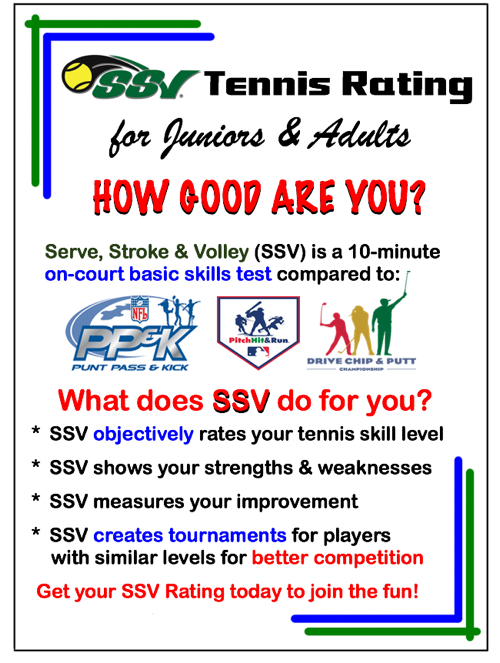
What
is SSV?
-
Its a basic skills
drill.
-
Its a game
-
It's an evaluation
-
Its a
rating.
-
Its an
objective method of
measuring tennis ability.
What's
SSV compared with?
-
A national junior competition
like:
-
Football's
Punt, Pass &
Kick
-
Baseball's
Pitch, Hit &
Run
-
Golf's Drive,
Chip &
Putt
Why
use
SSV?
-
To find out how good you
are.
-
To measure your improvement.
-
To place you in the
right game.
-
To introduce you to the
game.
Why
SSV?
-
Golfer's know how good they
are.
-
Bowler's know how good they are.
-
The score in
tennis doesn't tell
you.
-
Only a winner and a
loser.
-
SSV allows you to play against the
game
itself.
-
A score in SSV
tells you how good you
are.
-
Like golf and bowling, its
an objective
format. back to top
How
does it
work?
-
Players hit balls to target areas with
different strokes.
-
Points are scored for control
and
power.
-
Control is the first
bounce.
-
Power is the
second bounce.
-
The combined total points for control
and
power is the SSV score. back to top
How
is the ball put into
play?
-
A ball is fed with an underarm ball
toss.
-
It is the best way for
different people
to deliver the same ball.
-
It does not
intimidate a beginner.
-
It requires good stroke production
to
generate power. back to top
Why
score power?
-
In many sports like
tennis,
better players have both more control and
power.
-
In golf, control is direction and
power is
distance.
-
In SSV, control is hitting a
target area and power is
the depth of the second bounce.
-
The credibility of SSV is due to scoring
both control and power. back to top
Why Score the second
bounce?
-
Speed could indicate
power.
-
Impact could
indicate power.
-
These are too complicated to
measure
effectively.
-
A ball hit hard has a deeper second
bounce
than a soft ball. back to top
Doesn't
a topspin lob have a deep second
bounce?
-
Yes, and it scores high in
SSV.
-
A topspin lob is an
effective
shot.
-
It takes a
good player to
consistently hit topspin lobs.
-
Better
players score even higher
when they use topspin
lobs.
-
Deep second
bounce is an accurate
description of the power
score.
-
Power
sounds better than deep
second bounce. back to top
How
do you know SSV works?
-
Thousands of players have used SSV with
excellent response from the players and teaching
pros.
-
Tournaments have been run using the SSV
score to
seed the draw.
-
Over 80% of the matches were
won
by the player with the highest SSV. back to top
How
do
you stop players from sandbagging?
-
Good question.
-
You can't, but you can remove the incentive to sandbag.
-
Have round robin or league
formats where everyone plays the same amount of
tennis.
-
Allow high SSV players to
play
down.
-
Don't allow low SSV players
to play
up.
-
Lesser players like playing
stronger players as long as
they don't get eliminated from the event like
in traditional tournaments.
-
The stronger players
will want to
play at their own level.
-
With SSV as
a minimum requirement
for a level, the stronger players will
make sure they score
well on SSV. back to top
How
does SSV help the
teaching pro?
-
SSV is objective.
-
The pro does not
get negative
feed back from a player or parent when they asked 'How
good am I doing?'.
-
With the SSV score as the answer, the pro has a positive role in
helping the player improve his or her skills.
-
Players will see
their improvement in higher SSV
scores.
-
Players will have
more fun because they will be in the right
game.
-
The pro will see an
increase in
lessons.
-
The pro will see an
increase in program
participation. back to top
What
is the SSV Tennis Website
(www.ssvtennis.com)?
-
It's a place to get information
about SSV.
-
It's a national
database.
-
Pros can
register their players.
-
Players can see their own national SSV rankings by age division.
-
Pros and
players can see national
averages by age
division.
-
SSV events
and results will
be
posted. back to top
|
|